How it works

Understand it. Fix it. Grow it. Optimise it. Empower it with AI.

Ten stages, running as a loop rather than a checklist. The last stage feeds the first, which is why the work compounds instead of resetting every time a new supplier arrives.

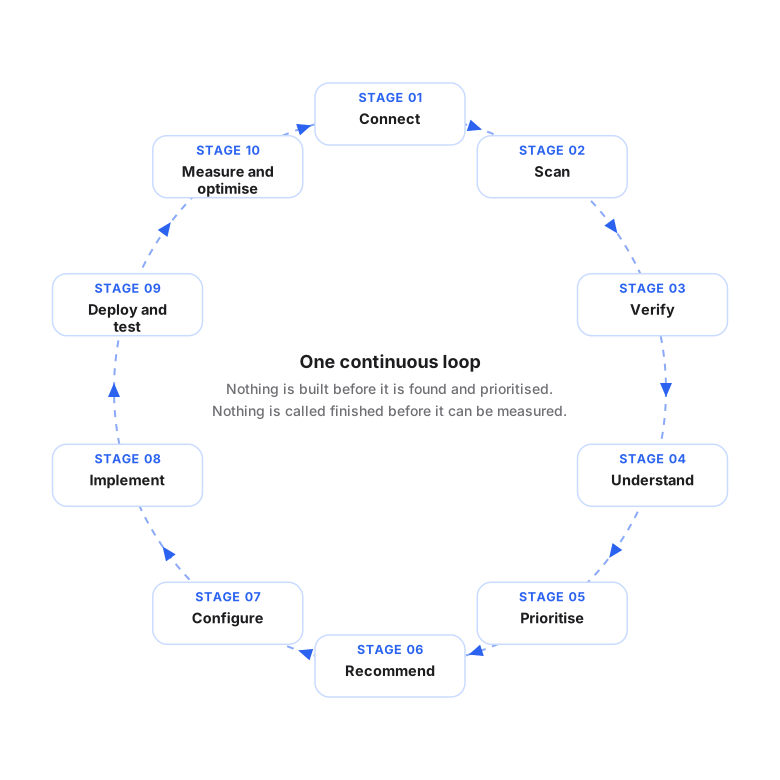
The loop

Nothing is built before it has been found, verified and prioritised. Nothing is called finished before it can be measured.

  1. Connect

  2. Scan

  3. Verify

  4. Understand

  5. Prioritise

  6. Recommend

  7. Configure

  8. Implement

  9. Deploy and test

  10. Measure and optimise

  11. Back to stage 1

    What the measurement shows becomes the input for the next round of work.

Read the ten stages as text
  1. Connect Agree scope and access. You stay the owner of every account, domain and dataset — we are added as a user, never as the holder.
  2. Scan Automated checks run against the public surface of the business: the website, its markup, its performance and the tracking it exposes.
  3. Verify A person checks the machine's findings. False positives are removed and anything the scanner could not see is marked unknown rather than guessed.
  4. Understand Findings are read against how the business actually runs — what the offer is, who buys it, and where enquiries currently go.
  5. Prioritise Issues are ordered by the damage they do and the effort to fix, not by what is easiest to sell.
  6. Recommend A written plan: what to change, in what order, what it makes possible, and what is explicitly out of scope.
  7. Configure Accounts, tracking, CRM structure and campaign scaffolding are set up so the work has something correct to sit on.
  8. Implement Strategists, marketers, content partners and engineers build the thing — website, campaign, integration, automation or system.
  9. Deploy and test Released, then tested against the original finding. A fix is not finished because it shipped; it is finished when the check passes.
  10. Measure and optimise The result is reported against revenue, and what is learned goes back into the next round of work.

Stage ten returns to stage one: what the measurement shows becomes the input for the next round of work.

What happens at each stage

Stages one to six are the diagnosis. Seven to ten are building and operating what the diagnosis found.

Stage 01 · Diagnosis

Connect

Agree scope and access. You stay the owner of every account, domain and dataset — we are added as a user, never as the holder.

Stage 02 · Diagnosis

Scan

Automated checks run against the public surface of the business: the website, its markup, its performance and the tracking it exposes.

Stage 03 · Diagnosis

Verify

A person checks the machine's findings. False positives are removed and anything the scanner could not see is marked unknown rather than guessed.

Stage 04 · Diagnosis

Understand

Findings are read against how the business actually runs — what the offer is, who buys it, and where enquiries currently go.

Stage 05 · Diagnosis

Prioritise

Issues are ordered by the damage they do and the effort to fix, not by what is easiest to sell.

Stage 06 · Diagnosis

Recommend

A written plan: what to change, in what order, what it makes possible, and what is explicitly out of scope.

Stage 07 · Delivery

Configure

Accounts, tracking, CRM structure and campaign scaffolding are set up so the work has something correct to sit on.

Stage 08 · Delivery

Implement

Strategists, marketers, content partners and engineers build the thing — website, campaign, integration, automation or system.

Stage 09 · Delivery

Deploy and test

Released, then tested against the original finding. A fix is not finished because it shipped; it is finished when the check passes.

Stage 10 · Delivery

Measure and optimise

The result is reported against revenue, and what is learned goes back into the next round of work.

What this does and does not do

Being clear about the boundary matters more than sounding impressive.

What you get

  • Automated technical checks against the public version of your website
  • A score with every check itemised as pass, warning, fail or unknown
  • A business audit covering revenue visibility, spend, CRM, automation and AI readiness
  • Category scores, named weak points and a prioritised roadmap
  • A written implementation scope stating what is included and what is not

What it does not do

  • Guaranteed revenue, lead volume, ranking or score outcomes — results depend on access, architecture, scope and the issues detected
  • A live connection to your ad accounts. There is no automated account connection today; advertising findings come from what you share with us
  • Any change to your website, tracking or accounts without your explicit say-so
  • Filling an unknown with a plausible guess. If a check could not be verified, it is reported as unknown

Stage one starts now

No sales call required to see where you stand.